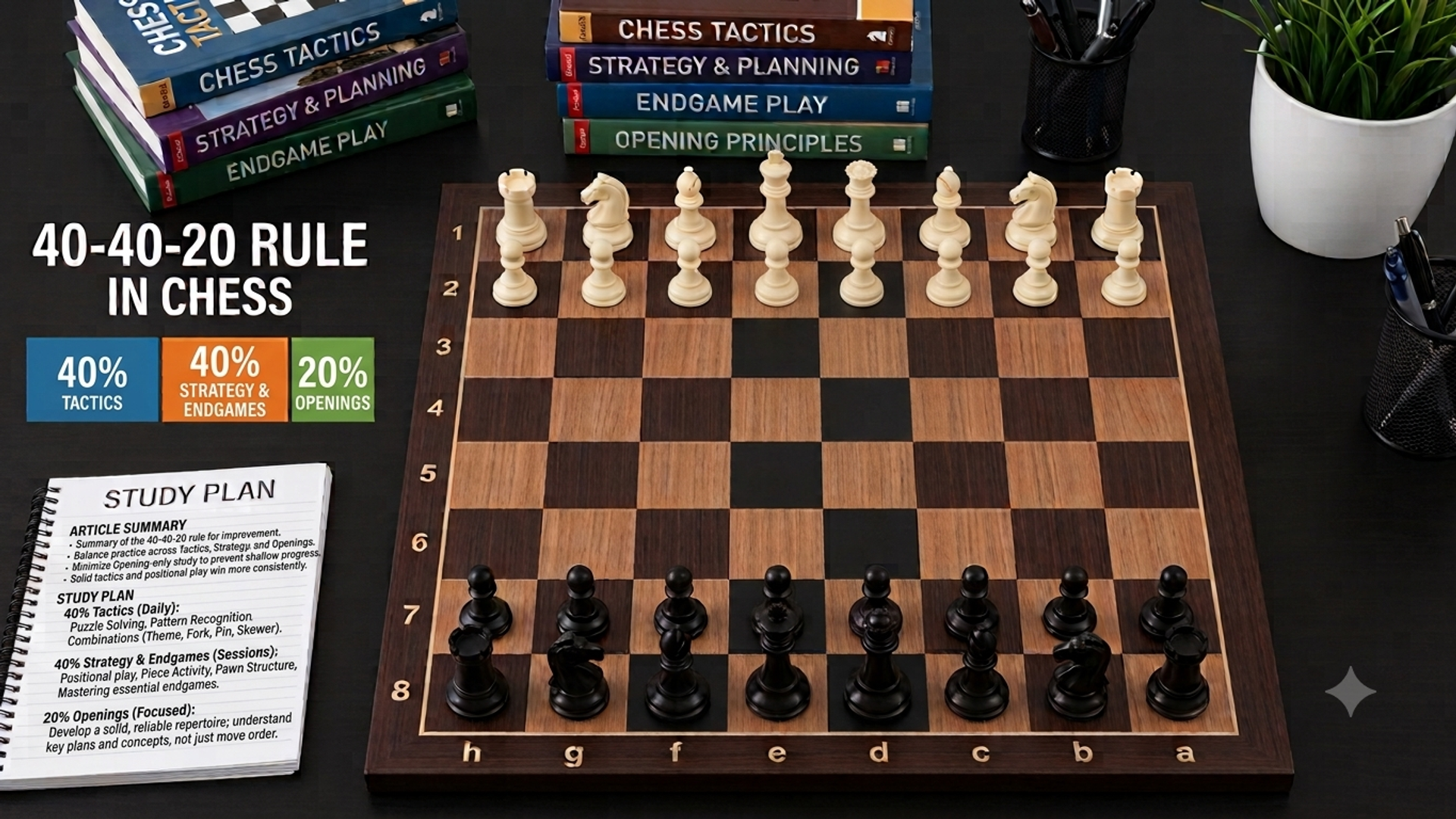
The 40-40-20 Rule in Chess: Why Most Players Study the Wrong Things
If you've ever wondered why your rating isn't improving despite spending hours watching opening videos, you're not alone.
One of the biggest mistakes club players make is believing that better openings automatically lead to better results. In reality, most games are not lost because someone forgot move 14 of the Sicilian Defence. They're lost because of missed tactics, poor planning, or a misunderstanding of the position.
That's where the 40-40-20 rule comes in.
It's not a strict formula, but it's a simple training philosophy that has helped countless players focus on what actually wins games.
What Is the 40-40-20 Rule?
The idea is straightforward:
- 40% Tactics
- 40% Strategy and Endgames
- 20% Openings
The exact percentages aren't set in stone, but the message is clear: spend most of your time improving the skills that decide the majority of games.
40% Tactics: The Fastest Way to Improve
No matter your rating, tactical ability is one of the strongest predictors of success.
Strong tactical players don't just spot combinations—they also avoid blunders, calculate more accurately, and recognise dangerous positions before it's too late.
Regular tactical training helps you:
- Find combinations faster
- Improve calculation
- Develop better board vision
- Recognise checkmate patterns
- Convert winning positions with confidence
The key isn't simply solving hundreds of puzzles. It's understanding why you missed them.
Instead of rushing through exercises, spend time calculating variations without moving the pieces, then analyse every mistake carefully. One deeply understood puzzle is often worth far more than ten solved by guessing.
40% Strategy and Endgames: Where Most Games Are Really Played
Once the opening is over, many players feel lost.
They know a few opening moves but have no clear plan once the position becomes original.
Studying strategy teaches you how to think rather than what to memorise.
You'll learn to:
- Create long-term plans
- Improve your pieces
- Recognise weak squares
- Understand pawn structures
- Evaluate positions correctly
- Know when to attack and when to improve your position
Endgames deserve just as much attention.
Even if you don't reach many pure endgames, studying them develops calculation, precision and piece coordination that improves every phase of your game.
Important topics include:
- King and pawn endings
- Rook endgames
- Opposition
- Triangulation
- Good and bad bishops
- Outposts
- Open files
- Piece activity
Why Only 20% on Openings?
This surprises many players.
Openings are enjoyable to study, and it's tempting to believe that learning another variation will instantly improve your results.
But unless you're playing at a very high competitive level, opening preparation rarely decides the outcome of your games.
Instead of memorising dozens of variations, focus on understanding:
- Development
- King safety
- Control of the centre
- Typical middlegame plans
- Common tactical ideas
- Characteristic pawn structures
A small opening repertoire that you genuinely understand is usually far more valuable than memorising hundreds of engine moves you'll never remember over the board.
The Missing Piece: Analysing Your Own Games
At London Chess Academy, there's one area we believe deserves even more attention than any percentage can capture:
Analysing your own games.
This is where real improvement happens.
Many players finish a tournament, briefly glance at the result, and immediately move on to the next game. Unfortunately, that means they keep repeating the same mistakes week after week.
Our coaching follows a different philosophy.
Rather than simply showing the "best move", we teach students to understand how they were thinking during the game.
We ask questions like:
- Why did this move seem attractive?
- What important information was overlooked?
- What alternative plans were available?
- Which recurring pattern caused the mistake?
Only after understanding the thought process do we compare it with stronger alternatives.
This approach helps students eliminate the root cause of mistakes instead of just memorising corrections.
Whether the game was won or lost, every game becomes a personalised lesson.
For many players, one deeply analysed game provides more improvement than hours of passive opening study.
Does the Rule Change as You Improve?
Absolutely.
Beginners (Under 1000)
The priority should be:
- Basic tactics
- Checkmate patterns
- Piece safety
- Fundamental endgames
- Basic opening principles
There's little benefit in memorising long opening variations at this stage.
Intermediate Players (1000–1800)
This is where the 40-40-20 rule works particularly well.
Players already know the basics but still gain enormous value from improving tactical vision while building positional understanding and endgame technique.
Advanced Players (1800+)
As players become stronger, opening preparation naturally becomes more important.
Tournament players often spend additional time preparing specific variations and analysing opponents.
Even then, tactical sharpness, strategic understanding and high-quality game analysis remain essential throughout a player's chess career.
A Sample 10-Hour Weekly Training Plan
If you study around ten hours each week, a balanced schedule might look like this:
- 4 hours — Tactical puzzles and calculation
- 4 hours — Strategy, endgames and analysing your own games
- 2 hours — Opening preparation and repertoire review
The exact balance can change depending on your goals, but avoiding an opening-heavy schedule will usually produce much faster improvement.
Common Mistakes That Hold Players Back
Many players unknowingly slow their progress by:
- Spending most of their time memorising openings
- Solving puzzles without reviewing mistakes
- Ignoring endgames completely
- Never analysing their tournament games
- Studying without a structured plan
Replacing these habits with purposeful training almost always leads to more consistent improvement.
Is the 40-40-20 Rule Proven?
Not scientifically.
It's not an official chess rule or a mathematical formula.
Instead, it's a practical guideline used by many experienced coaches because it reflects where most improving players gain the greatest benefit.
The exact balance will always depend on your rating, ambitions and tournament schedule.
Improve Smarter, Not Just Harder
At London Chess Academy, we don't believe in generic training plans.
Every student develops different habits, makes different mistakes and thinks differently over the board.
That's why our coaching focuses heavily on personal game analysis. Rather than simply reviewing engine moves, we identify the thinking patterns behind each decision and build training around the areas that will make the biggest difference.
Combined with structured tactical training, strategic understanding, endgame study and a carefully chosen opening repertoire, this creates a training programme that's tailored to the individual—not a one-size-fits-all system.
After all, the quickest way to improve isn't studying more chess.
It's studying the right chess.
Frequently Asked Questions
Is the 40-40-20 rule good for beginners?
Yes. Beginners benefit most from tactics, basic chess principles and simple endgames, while keeping opening study relatively light.
Should stronger players still follow it?
Generally yes, although stronger tournament players often increase the time spent on opening preparation. Tactical and strategic training should never disappear from your routine.
Is studying openings a waste of time?
Not at all. Openings matter—but understanding the ideas behind them is usually far more valuable than memorising long variations.
What's the fastest way to improve at chess?
For most players, the biggest gains come from combining tactical training with careful analysis of your own games, supported by strategic study, endgames and personalised coaching. That's where lasting improvement happens.